
Porous Pipe Reticulation System for Homes, Offices & Commercial Buildings.
Install Termite Protection Once. Maintain It Forever Without Drilling.
For homes you plan to keep for 20+ years, reticulation is the ultimate investment in peace of mind.
- 25+ Years Installation Experience
- 1 Lakh+ Homes & Offices Protected
- ISO Certified Installation Teams
- Government Approved Systems
- Lifetime Technical Support
- Serving 80+ Cities Pan-India
- Transferable to Future Owners
What Is a Termite Reticulation System?
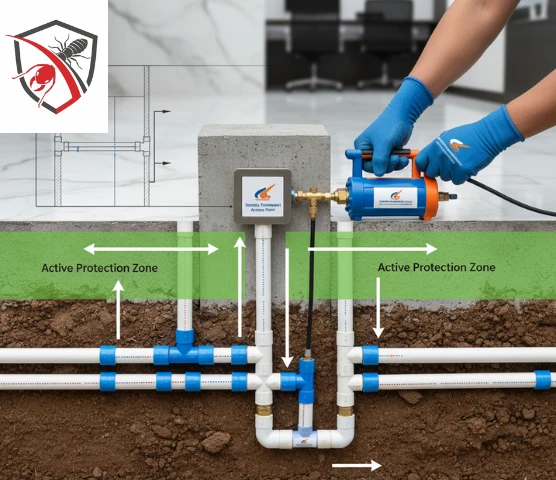
A termite reticulation system (also called a porous pipe termite system) is a network of perforated PVC pipes installed horizontally beneath your building’s floor and around its perimeter before flooring is laid.
How the system works
- Initial Installation: Pipes laid in a grid beneath the slab.
- First Treatment: Termiticide pumped evenly through the network.
- Maintenance Top-Ups: Refilled after 5–7 years without drilling.
- Result: Lifetime-ready protection with zero disruption.
Why it’s revolutionary: Reticulation is replenishable — protection is maintained, not replaced.
Request Installation Quote
Why Reticulation Matters
Traditional termite treatment has a built-in expiration date — and homeowners pay the price later.
-
1
Option 1: Do Nothing
Risk termite re-infestation once chemicals degrade (after 5–7 years). Cheap upfront — but repairs can cost ₹50,000–₹1,00,000+.
-
2
Option 2: Post-Construction Injection
Drill tiles, inject chemicals, cap holes. Costs ₹30k–₹60k, takes days, disrupts your home, and leaves visible damage.
-
3
Option 3: Install Reticulation (Smart Choice)
One-time installation (~₹50k–₹1L). Then every 5–7 years, a simple ₹10k–₹15k top-up — no drilling, no mess.
-
✓
The Math Is Clear
Over 30 years, reticulation costs less than repeated post-construction treatments — while preserving your flooring and sanity.
Request Installation Quote
How Reticulation Works
(The System in Action)
A long-term termite protection system designed once and maintained for decades.
Phase 1: Design & Layout (Assessment)
We map the property footprint, identify treatment zones, calculate pipe spacing (30–60 cm), select discreet external port locations, and prepare a detailed layout drawing.
Outcome: You know exactly how the system will look and function.
Phase 2: Installation (Before Flooring)
Porous PVC pipes are laid at plinth level in a grid pattern, connected to headers and external ports. The network is pressure-tested and left ready for charging.
Outcome: An invisible chemical distribution network under your floor.
Phase 3: Initial Termiticide Filling
Termiticide is pumped through the system, saturating the surrounding soil evenly. Excess chemical returns through the circuit, completing the loop in 3–4 hours.
Outcome: Full protection — entire soil envelope treated.
Phase 4: Maintenance Top-Ups (Every 5–7 Years)
A simple pump connection refreshes the system in 2–3 hours. No drilling, no mess. Typical cost: ₹10k–15k.
Outcome: 20–30 year protection with minimal disruption.
Request Installation Quote
Why Choose Reticulation?
The 10 Big Advantages
- Lifetime Protection Without Disruption
No drilling, no mess, no moving furniture — maintenance via external ports only.
- Lower Long-Term Cost
Costs less over 30 years than repeated post-construction treatments.
- Multi-Story Coverage
Even protection across floors, basements, and perimeters.
- Ideal for Premium Interiors
No risk to marble, tiles, modular kitchens, or luxury flooring.
- Transparent Protection Schedule
You control timing. No surprise emergencies.
- Transferable to Future Owners
Adds resale value with built-in termite protection.
- New & Existing Buildings
Install during construction or retrofit later.
- Compliance & Documentation
Meets long-term termite management standards.
- Works With Other Treatments
Enhances soil or injection treatments.
- Future-Proof Investment
Designed for buildings lasting 30–50+ years.
Schedule Installation Assessment
Installation Scenarios:
Pre-Construction vs. Retrofit
Reticulation can be installed at different stages of a building’s life. The timing affects cost, disruption, and ease — we help you choose the best path.
New Building (During Construction)
- Pipes laid during foundation or plinth work before PCC flooring
- No disruption to finished interiors
- Cheapest option — labor aligns with construction work
- External ports positioned before landscaping
Best choice: Cleanest, fastest, most cost-effective installation.
Existing Building (Retrofit Installation)
- Careful drilling at floor junctions if flooring is sealed
- Pipes routed through hollow walls or foundation cavities
- Perimeter pipes installed via shallow trench
- External ports placed in utility or landscape areas
Timeline: 2–3 days. Moderate, well-managed disruption.
Building Undergoing Renovation
- Pipes installed before new flooring is laid
- External pipes installed alongside renovation work
- System ready for charging immediately after renovation
Optimal timing: Combines low disruption with long-term efficiency.
Schedule Installation Assessment
Installation Scenarios:
Pre-Construction vs. Retrofit
Reticulation adapts to your building’s lifecycle. The right timing saves cost, effort, and disruption.
New Building (During Construction)
Best Time · Lowest Cost
- Pipes laid before PCC flooring during foundation or plinth work
- No disruption to finished interiors
- Lowest cost — aligned with construction labor
- Ports positioned before landscaping
Existing Building (Retrofit Installation)
Possible · Planned Disruption
- Careful drilling at floor-wall junctions if flooring is sealed
- Pipes routed through hollow walls or foundation cavities
- Perimeter trenching around building edge
- External ports placed in utility or landscape zones
- 2–3 days for typical residence
Building Under Renovation
Optimal Timing
- Pipes installed before new flooring is laid
- External pipes installed alongside renovation work
- System ready for chemical charging immediately
- Minimal additional effort during renovation
Why Choose Us for Reticulation Installation?
Thousands of systems installed with precision layouts and pressure-tested networks.
Dedicated reticulation engineers — not generic pest control technicians.
Site-specific layout drawings shared before installation begins.
CIB-approved pipes, fittings, and signed pressure-test certification.
Itemized quotes based on plinth area, complexity, and timing.
Maintenance top-ups, inspections, port repairs — one call for life.
Drawings, photos, schedules, warranties — adds resale value.
Experienced teams across metros and Tier-2 cities.
Schedule Installation Assessment
Frequently Asked Questions
A termite reticulation system is a network of perforated PVC pipes installed beneath your building’s floor (usually at plinth level) before flooring is laid, or retrofitted later. These pipes connect to external ports above ground. Every 5–7 years, termiticide is pumped through these ports, circulating through the entire pipe network and re-saturating the soil. It works like drip irrigation for termite protection — no drilling required once installed.
Traditional termite treatment expires in 5–7 years and requires drilling through tiles each time, costing ₹30k–60k per cycle. Reticulation costs more upfront (₹50k–100k) but is cheaper over 30 years, requires only ₹10k–15k top-ups, and avoids interior damage and disruption. For long-term homeowners, it’s the smarter investment.
Yes. Retrofit installation involves careful drilling at floor junctions, threading pipes through hollow walls or foundation cavities, and installing perimeter pipes in landscaping. The process takes 2–3 days and is planned to minimize disruption. Installation during construction is easier and cheaper, but retrofit is absolutely possible.
New construction: 1–2 days of installation.
Retrofit projects: 2–3 days depending on complexity.
Initial chemical charging adds one more day. Total timeline is usually 3–5 days.
Cost depends on property size, building type, new vs retrofit, and soil conditions. Approximate ranges: 1500 sq ft: ₹50k–75k; 3000 sq ft: ₹75k–120k; 5000+ sq ft: ₹120k–200k+. This includes design, materials, installation, and initial chemical charge.
Termiticide remains effective for 5–7 years. Over time, soil microbes naturally break it down, which is why scheduled maintenance top-ups are recommended every 5–7 years.
A technician connects a pump to the external ports and recirculates fresh termiticide through the system for 2–3 hours. The soil is re-saturated, restoring protection for another 5–7 years. No drilling, no mess. Typical cost: ₹10k–15k.
The pipes are underground and invisible once flooring is laid. You’ll see only the external ports (usually 2–4), placed in landscaping or utility areas. During design, we show you all port locations in advance.
During construction: minimal disruption. Retrofit: moderate short-term disruption (2–3 days), but well-planned. After installation, maintenance causes zero disruption.
Yes. Designs include basement slabs, retaining walls, and perimeter protection across all levels. A custom layout is provided for each building.
Yes. The system transfers with the property, adding resale value. Documentation and maintenance schedules are provided for new owners.
Yes. Since maintenance never requires drilling, reticulation is ideal for marble, polished concrete, premium tiles, and luxury interiors.
CIB-approved termiticides such as Imidacloprid (non-repellent) or Chlorpyrifos (repellent). Selection depends on soil and site conditions.
Yes. The system operates underground and poses no exposure risk once sealed. Chemicals are approved and professionally applied.
Yes, with building management approval. Installation depends on access to common areas, basements, or shared service spaces.
Reticulation can be installed afterward and complements existing treatment. Many homeowners upgrade for lifetime protection.
Suitability depends on building type, foundation access, soil type, and flooring access. A free site assessment determines feasibility.
Ports are durable but can occasionally need maintenance. Repairs or replacements are covered under lifetime technical support.
Yes. Retrofitting is possible at any time, even after standard treatment.
Inform us before renovation so we can protect or relocate the system if required.
Yes. Systems are typically warranted for 5 years covering pipes, ports, and connections.
We provide a maintenance schedule and reminders. Booking is simple and flexible.
Yes. Reticulation handles termites and can be paired with general pest management.
No. The system transfers with the property, not the owner.
Reticulation is proactive and continuous. Bait stations are reactive and slow. Many customers use both together.
Yes. Sandy soil needs tighter spacing; clayey soil allows wider spacing.
Design is adjusted for groundwater levels to ensure long-term integrity.
No. Reticulation requires professional design, installation, and pressure testing.
Usually no. For large commercial projects, regulations may vary.
Pipes and ports last 20–30+ years. Only the chemical needs periodic renewal.
Yes, with special care and coordination with architects or heritage consultants.
After 5–7 years, protection weakens. You’ll need a top-up or face traditional drilling again.
Get your free estimate
Get a Quote
Every day you wait, termites are eating deeper into your walls, destroying wooden structures, and weakening your home’s integrity. By next week, the damage could be 40% worse. By next month, repair costs could double.